Canadian Tech to Boost Pakistan’s Heavy Oil
Pakistan has taken another significant step toward strengthening its domestic energy sector by signing a strategic agreement with Canadian technology company Synergetic Oil Tools Inc. to improve production from the country’s heavy crude oil fields.
The agreement, signed by the Oil and Gas Development Company Limited (OGDCL), is aimed at introducing advanced Passive Energy Tool technology to enhance oil recovery, improve operational efficiency, and reduce production costs.
The collaboration reflects Pakistan’s broader strategy to increase local oil and gas production, lessen dependence on imported petroleum products, and improve the country’s long-term energy security. Rising energy import costs have placed considerable pressure on Pakistan’s foreign exchange reserves and current account in recent years, making domestic resource development a national priority.
Under the agreement, Synergetic Oil Tools Inc. will deploy its proprietary Passive Energy Tool technology at OGDCL-operated heavy crude oil wells.
The technology is specifically designed for highly viscous crude oil reservoirs, where extracting oil is often more difficult and expensive than conventional production. By optimizing the physical characteristics of crude oil and improving fluid flow within the well, the technology is expected to enhance production rates while reducing operational challenges.
According to OGDCL, the Passive Energy Tool system offers several operational benefits. These include improving flow assurance in heavy oil wells, reducing the frequency of costly well workovers, minimizing production downtime, lowering operating expenses, and decreasing the need for production chemicals. Collectively, these improvements are expected to increase the efficiency and profitability of heavy oil operations while extending the productive life of existing wells.
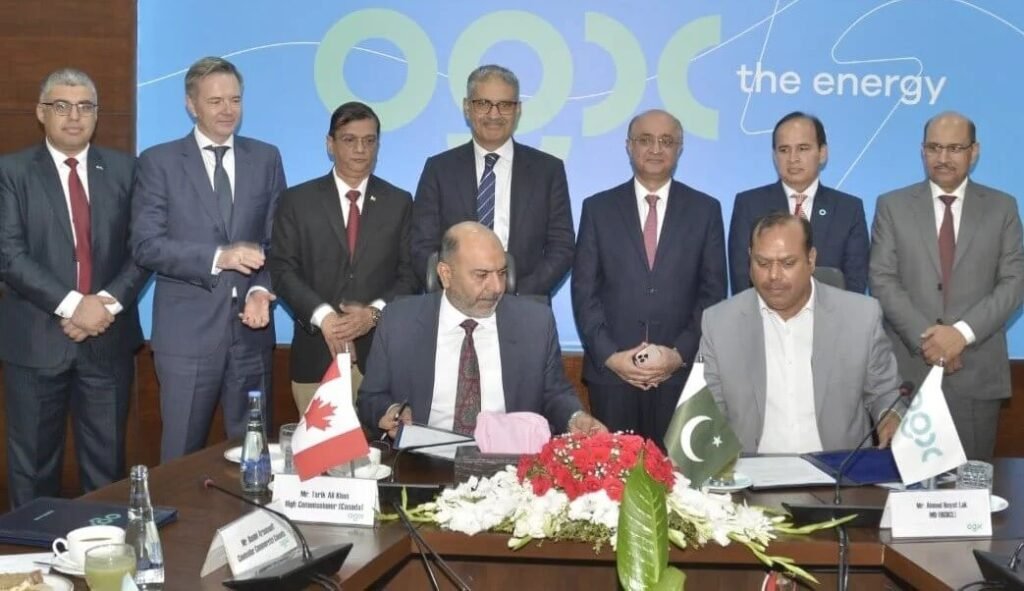
The agreement was formally signed in Islamabad in the presence of senior officials from both organizations. OGDCL Managing Director and Chief Executive Officer Ahmed Hayat Lak represented the Pakistani state-owned energy company, while Synergetic Oil Tools President and Chief Executive Officer Brian Herman attended on behalf of the Canadian firm. The ceremony was also witnessed by Canadian High Commissioner to Pakistan Tarik Ali Khan, underscoring the importance of the partnership in strengthening bilateral economic and technological cooperation between Pakistan and Canada.
Speaking during the signing ceremony, the Canadian High Commissioner described the partnership as an important milestone for Pakistan’s energy industry. He noted that the introduction of advanced Canadian technology would help improve heavy crude oil extraction while supporting the modernization of Pakistan’s oil production sector. He also emphasized that the collaboration demonstrates Canada’s commitment to promoting innovation and investment opportunities in Pakistan’s energy market.
The agreement comes at a time when Pakistan is actively seeking to expand domestic oil and gas production to reduce its reliance on imported fuel. The country continues to spend substantial amounts on petroleum imports each year, with official estimates placing annual import costs at approximately Rs4.4 trillion, or nearly $16 billion. Most of Pakistan’s imported petroleum products originate from major Gulf suppliers, including Saudi Arabia, the United Arab Emirates, Kuwait, and Qatar.
Recent geopolitical tensions in the Middle East have further highlighted the importance of strengthening domestic energy resources. Supply disruptions and uncertainty in global oil markets have reinforced Pakistan’s efforts to diversify its energy strategy and improve local production capacity. The government has also been exploring additional measures to enhance energy security, including proposals to establish strategic crude oil reserve facilities as part of a planned Energy City near one of the country’s ports. The initiative is intended to attract investment from Gulf energy producers while ensuring a more stable fuel supply during periods of international market volatility.
OGDCL remains the largest exploration and production company in Pakistan and plays a central role in the country’s energy industry. The state-owned enterprise holds the largest exploration acreage in the country and possesses the highest oil and gas reserves among domestic producers. The company currently produces approximately 166,497 barrels of oil equivalent per day, accounting for nearly 49 percent of Pakistan’s total crude oil production, 28 percent of its natural gas output, and 34 percent of the country’s liquefied petroleum gas (LPG) production.
The company operates several major oil and gas fields across Pakistan, including Qadirpur, Nashpa, Mela, KPD-TAY, and Bettani. In addition to maximizing production from existing assets, OGDCL continues to expand its exploration portfolio by acquiring new exploration blocks and investing in advanced technologies to improve recovery rates.
Earlier this year, OGDCL announced a successful oil and gas discovery at the Baragzai X-01 exploratory well in Khyber Pakhtunkhwa, reinforcing its ongoing efforts to identify new hydrocarbon reserves. The discovery added momentum to the company’s exploration activities and highlighted the potential for further resource development within the country.
Pakistan has also accelerated exploration efforts through new licensing agreements. At the end of last year, the government signed five exploration agreements with state-owned and private-sector companies covering three offshore and two onshore exploration blocks. These projects are expected to attract fresh investment, increase exploration activity, and support future domestic energy production.
The partnership between OGDCL and Synergetic Oil Tools represents another important milestone in Pakistan’s drive to modernize its oil and gas industry. By combining international technology with domestic energy resources, the initiative aims to improve production efficiency, reduce operational costs, and contribute to the country’s broader objective of achieving greater energy independence while supporting sustainable economic growth.
About The Author