38 Dead After 7.7-Magnitude Quake Hits Indonesia
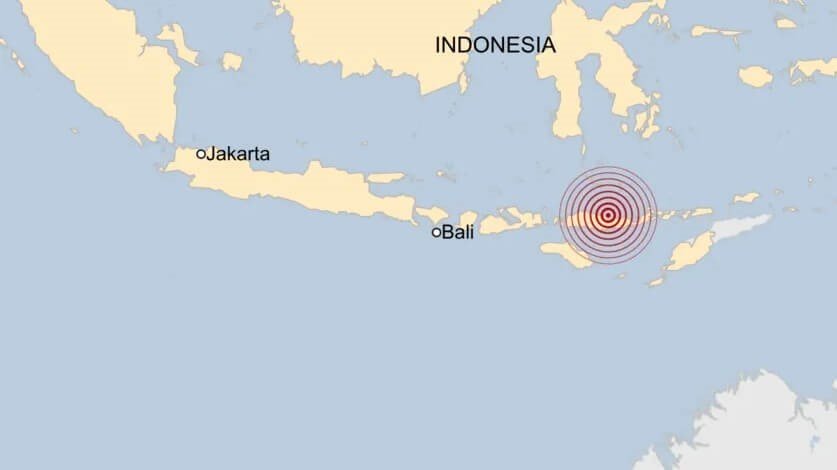
At least 38 people have been killed after a powerful 7.7-magnitude earthquake struck Indonesia’s East Nusa Tenggara province early Saturday, collapsing buildings and triggering a temporary tsunami warning, media houses report said.
The earthquake struck the island of Flores shortly before 5:00 a.m. local time, when many residents were still asleep. East Nusa Tenggara Governor Emanuel Melkiades Laka Lena said the five victims were killed after rubble from collapsing structures fell on them while they slept.
Search and rescue teams were deployed across affected areas as authorities worked to determine the full scale of the destruction and search for people who may still be trapped under damaged buildings.
Indonesia’s Meteorology, Climatology and Geophysics Agency said the earthquake occurred at a depth of around 15 kilometres, making it a relatively shallow quake capable of producing strong shaking at the surface.
The main earthquake was followed by dozens of aftershocks, including one measuring 6.1 in magnitude. The continuing tremors raised concerns about further building collapses and complicated rescue operations.
A tsunami warning was issued shortly after the earthquake, prompting residents in coastal communities to move to safer areas. The warning was lifted about three hours after the initial earthquake after authorities determined that the immediate tsunami threat had passed.
Dramatic video footage from the port in Maumere showed the strength of the earthquake. Large sections of concrete broke away from a terminal building and fell onto passengers waiting to board an inter-island ferry. Some people were reportedly thrown into the sea after a gangway leading to the vessel collapsed.
Following the tsunami warning, streams of residents could be seen moving inland on motorcycles as people sought higher and safer ground.
The affected region is remote and mountainous, meaning authorities could take time to assess the complete extent of the damage. Communications and access to some areas may also be difficult, potentially slowing rescue and relief operations.
Indonesia’s national disaster mitigation agency, BNPB, urged residents to remain calm and avoid coastal areas until authorities determine that conditions are safe.
The agency also warned people not to enter damaged buildings, particularly structures showing cracks or other signs of instability.
“Residents should also avoid entering buildings, especially those that have already sustained cracks or structural damage,” BNPB said.
Officials said a rapid assessment was underway to establish the number of casualties, injuries and damaged structures. Authorities said they would release further information once the data had been verified.
Around 2,000 residents in Nagekeo were evacuated following the earthquake, with damage reported to several buildings.
Residents described the initial tremor as extremely powerful. Arnold Welianto, a resident of Talibura village in Sikka, East Nusa Tenggara, told the BBC that he had been asleep when the earthquake struck.
“I was startled awake and immediately went to my child’s room,” he said.
Rescue and emergency teams remain active in the affected areas, while authorities continue to monitor aftershocks and inspect buildings for structural damage.
The earthquake is the latest major seismic event to hit Indonesia, an archipelago located along the Pacific Ring of Fire, one of the world’s most active earthquake and volcanic zones. The country frequently experiences earthquakes, some of which can generate destructive tsunamis.
Officials have urged residents to follow instructions from emergency authorities and remain alert for further aftershocks as rescue operations continue.
About The Author