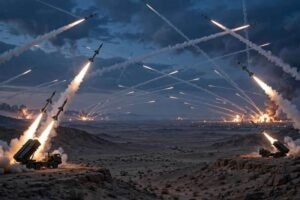
Iran Demands US Surrender as Trump Claims Victory in War
TEHRAN/WASHINGTON: Iran has intensified its defiant rhetoric against the United States, with a senior Iranian security official claiming that Washington has been severely weakened by the ongoing war and must surrender to Tehran‘s conditions to end the conflict.
Mohsen Rezaei, Secretary of Iran’s Supreme National Security Council, said late Monday that the US government had been “wrecked” by its military campaign against Iran. He urged the Trump administration to abandon what he described as fabricated reports about peace negotiations and accept Iran’s seven conditions for ending the war.
In a statement posted on social media platform X, Rezaei said the United States was behaving like a desperate gambler and needed to accept the new regional reality.
“The war on Iran has already wrecked the U.S. government. But Washington flails like a desperate gambler. FOLD YOUR HAND,” Rezaei wrote, adding that it was time for Washington to surrender to Iran’s conditions.
His remarks came as US President Donald Trump told reporters in Washington on Monday that the war with Iran was militarily “effectively over”, suggesting that his administration was not currently preparing to resume large-scale airstrikes.
However, the contrasting statements from Tehran and Washington highlight the significant differences between the two sides over the outcome of the conflict and the terms required for a permanent ceasefire.
Iran Sets Seven Conditions for Ending the War
Iran has repeatedly outlined seven conditions that it considers essential for any potential peace agreement with the United States.
Among Tehran’s longstanding demands are an end to the American blockade of Iranian ports and vessels, a comprehensive cessation of hostilities across all fronts and the lifting of economic sanctions on Iranian oil and gas exports.
Iran has also demanded the release of its state funds frozen abroad, war reparations and measures addressing other political, economic and security concerns.
Another major Iranian demand involves ending hostilities in Lebanon, including Israel’s military campaign against Hezbollah.
The conditions reflect Tehran’s position that a peace agreement must address the broader regional conflict rather than focus exclusively on direct military confrontation between Iran and the United States.
However, US Secretary of State Marco Rubio has dismissed Iran’s demands as unacceptable, indicating that Washington and Tehran remain far apart on the terms of a potential settlement.
Pentagon Claims Historic Military Victory Against Iran
Meanwhile, US Defense Secretary Pete Hegseth has continued to describe the American military campaign as a decisive victory, claiming that Washington has severely damaged Iran’s military capabilities.
During a Pentagon briefing on Tuesday, Hegseth said the United States had achieved a historic military victory through Operation Epic Fury.
He claimed that Iran’s navy had been destroyed, its air force grounded and its defence industrial base largely eliminated.
Hegseth also asserted that more than 80 percent of Iran’s nuclear industrial infrastructure had been destroyed and that the US blockade remained fully effective.
“Their navy sunk. Their air force grounded. Their defense industrial base — gone. More than 80 percent of their nuclear industrial base — gone. Their military in ruin. The ironclad blockade, UNBROKEN,” Hegseth said.
He further declared that the United States controlled the strategically important Strait of Hormuz.
However, Tehran has disputed Washington’s claims, insisting that its military and weapons production capabilities remain operational.
Iranian officials have previously claimed that the country’s weapons manufacturing capacity increased by 250 percent since the beginning of the war, allegedly with assistance from Russia and China. These claims have not been independently established.
Strait of Hormuz Remains a Major Flashpoint
Despite American claims of control over the Strait of Hormuz, maritime security remains a major concern.
The commander of US Central Command reportedly said he had flown over the strategic waterway in October and observed no Iranian Revolutionary Guard vessels.
He also described the shipping lanes protected by American forces as safe and clear for commercial traffic.
However, Iran has continued to claim attacks against commercial vessels using the designated shipping routes, including alleged missile and sea mine incidents.
The conflicting statements have raised questions about the security of international shipping through the Strait of Hormuz, one of the world’s most important energy transportation routes.
Any prolonged disruption in the waterway could affect global oil supplies, increase shipping insurance costs and put additional pressure on international energy markets.
For countries heavily dependent on imported petroleum, including Pakistan, continued instability in the Gulf could create additional economic challenges.
Iran’s Nuclear Programme Remains a Key Obstacle
Iran’s nuclear programme is another major unresolved issue in negotiations.
Much of the country’s nuclear infrastructure had already suffered serious damage during US and Israeli strikes in June 2025, before the current war began.
According to the information cited in the report, United Nations experts believe Iran still possesses approximately 972 pounds of uranium enriched to 60 percent purity.
Uranium enriched to this level is relatively close to the 90 percent enrichment generally associated with weapons-grade material.
However, the location and condition of the remaining stockpile remain uncertain. It is believed that some of the highly enriched uranium may be buried beneath facilities damaged during the previous strikes.
Iran has not agreed to renewed international monitoring of its nuclear programme or to the removal of its highly enriched uranium as part of a potential peace agreement.
The absence of an agreement on nuclear inspections and uranium stockpiles remains a significant obstacle to diplomatic progress.
US-Iran Peace Prospects Remain Uncertain
The latest statements from Iranian and American officials indicate that both sides continue to present the conflict as a military success while maintaining sharply different positions on ending hostilities.
President Trump’s suggestion that the war is effectively over militarily has raised expectations of a possible diplomatic opening. However, Iran’s insistence on its seven conditions and Washington’s rejection of key demands suggest that a comprehensive agreement remains unresolved.
The situation in the Strait of Hormuz, the future of Iran’s nuclear programme, economic sanctions and the wider conflict involving Israel and Hezbollah are likely to remain central issues in any negotiations.
For now, the conflicting claims of victory from Washington and Tehran underscore the uncertainty surrounding the future of the conflict and its potential consequences for regional stability, global energy supplies and international trade.
About The Author