Pakistan Navy: Always Ready, Always Vigilant
“Hasbuna Allahu wa Ni’mal Wakeel”. These words have long given strength to the men and women who stand watch over Pakistan’s waters. For them, faith is not separate from duty. It is part of the courage, discipline and determination required to serve at sea.
8 September is a time to remember these brave sailors who defended Pakistan and stood like a wall of steel protecting its waters, in its most difficult hours.
The strength of a navy is not measured by the number of ships it owns alone. Its real strength lies in the character of its sailors, the quality of its training and the courage with which it performs its duty. A smaller force can still achieve great things when it is disciplined, prepared and united by a clear purpose. The Pakistan Navy has proved this throughout its history.
On the night of 7–8 September 1965, a fleet of seven Pakistan Navy warships headed towards the Indian coastal town of Dwarka. The task group included PNS Babur, PNS Khyber, PNS Badr, PNS Jahangir, PNS Alamgir, PNS Shah Jahan and PNS Tipu Sultan. Their mission was to strike important shore installations and a radar station supporting Indian military operations.
The ships advanced through the darkness, carrying the hopes of a young nation and the responsibility of defending its honor. As they approached their target, every sailor knew that the operation demanded courage, accuracy and complete trust in one another. The bombardment damaged the radar station and other installations, while the sudden attack created alarm along the Indian coast.
The operation, known as Operation Somnath, was a daring achievement. The Pakistan Navy did not possess a numerical advantage, but its sailors had something equally important: preparation, discipline and determination. The success of the mission was not the result of size or strength alone. It was the result of careful planning and the courage to carry out that plan under difficult circumstances.
When the ships returned, they brought back more than the memory of a successful operation. They had demonstrated that battles are not won by weapons alone, but by the courage, discipline and determination of the people who wield them.
However, the sea has changed greatly since 1965. Modern naval warfare is no longer limited to guns, ships and submarines. Today, maritime forces must deal with long-range missiles, unmanned aircraft, cyber threats, satellite surveillance, electronic warfare and rapidly changing information systems.
The Pakistan Navy maintains this readiness through exercises that bring together ships, submarines, aircraft, marines, special forces and unmanned systems. These exercises allow crews to test their equipment, improve communication and prepare for situations in which several threats may appear at the same time.
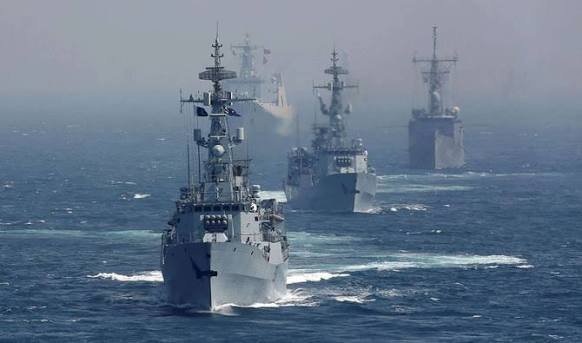
This commitment to readiness was demonstrated through SEASPARK-2026, a major maritime exercise held in Karachi. The exercise brought together Pakistan Navy ships, submarines, aircraft, unmanned systems, marines and special forces. It tested the services’ ability to operate together in a fast-changing security environment, combining conventional operations at sea with activity in the information domain.
SEASPARK-2026 was not simply a display of military prowess. It was a test of coordination, decision-making and endurance. Every movement, communication and response was examined to identify weaknesses and improve performance. The exercise showed that modern naval strength is built not only through new platforms, but also through constant training and the ability to respond as one united force.
Operational readiness also means protecting Pakistan’s maritime interests during times of tension. The country’s trade, energy supplies and communication links depend heavily on the sea. Keeping shipping routes open and ports secure is therefore a responsibility of national importance. The Navy protects not only the coastline, but also the economic lifelines that connect Pakistan to the world.
The world saw the full extent of these capabilities during Marka-e-Haq. As tensions with India escalated, the Pakistan Navy moved to secure the country’s waters on every front at once. Submarines held position beneath the surface, ready to respond without warning, while fast attack craft and surface ships maintained a constant presence across the Arabian Sea. Maritime patrol aircraft flew continuous sorties to track activity along the coast, and even in sensitive areas, no footing was given to the enemy. India’s own naval assets, despite years of expansion, were kept far from Pakistani waters, unable to test a coastline that was already fully covered. Throughout this period, Pakistan’s ports continued to function without interruption, and every trade route dependent on the sea kept moving exactly as it should have. Marka-e-Haq was operational readiness proven in real time, the same discipline that guided the ships toward Dwarka in 1965, applied to a battlespace that now includes drones, satellites and the information domain alongside ships and submarines.
A strong navy does not exist only to fight wars. It also plays an important role in preserving peace. Through multinational exercises and maritime cooperation, the Pakistan Navy works with ally countries to address shared challenges such as piracy, terrorism, trafficking and threats to commercial shipping.
Pakistan Navy ships have also taken part in international maritime security and anti-piracy patrols far from Pakistan’s own coast. These missions help protect the sea routes through which international trade passes. They may not always receive public attention, but they represent Pakistan’s commitment to peace and stability beyond its territorial waters.
Whenever the nation calls, Pakistan Navy always answers, be it during natural disasters and humanitarian emergencies. When storms, floods or other crises affect coastal communities, Pakistan Navy works to provide relief in every way it can.
Humanitarian assistance demands the same qualities as military service: discipline, courage and the ability to work under pressure. A warship can carry weapons, but it can also carry relief supplies. A helicopter used for surveillance can also search for stranded families. A sailor trained to defend the nation can become a rescuer when fellow citizens are in danger.
This is the human face of the Pakistan Navy. Their duty is not limited to moments of war. It continues whenever Pakistan needs a helping hand.
Each year on 8 September the nation honors the sailors who sailed towards Dwarka under the cover of darkness and completed a mission that became a symbol of courage. It honors the martyrs and veterans whose sacrifices strengthened Pakistan’s defences. It also salutes the men and women standing watch today, often far from their families and away from public attention.
The sea never sleeps. It tests a nation in darkness, in storms and in moments when no one is watching. But wherever Pakistan’s flag flies at sea, its sailors carry the same promise: to defend the motherland with courage, serve its people with honor and remain ready for every challenge.
The ships may change, technology may advance and threats may take new forms, but the spirit remains unshaken. Pakistan Navy stands guard with faith in its heart, courage in its actions, and love for country in its existence.
About The Author