Karachi’s Hidden Environmental Debt
472 Million Gallons of Sewage a Day — But How Much Is Actually Treated? — Pakistan’s largest city does not need another promise about wastewater treatment.
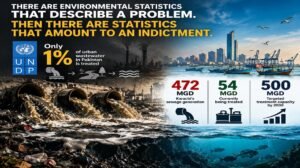
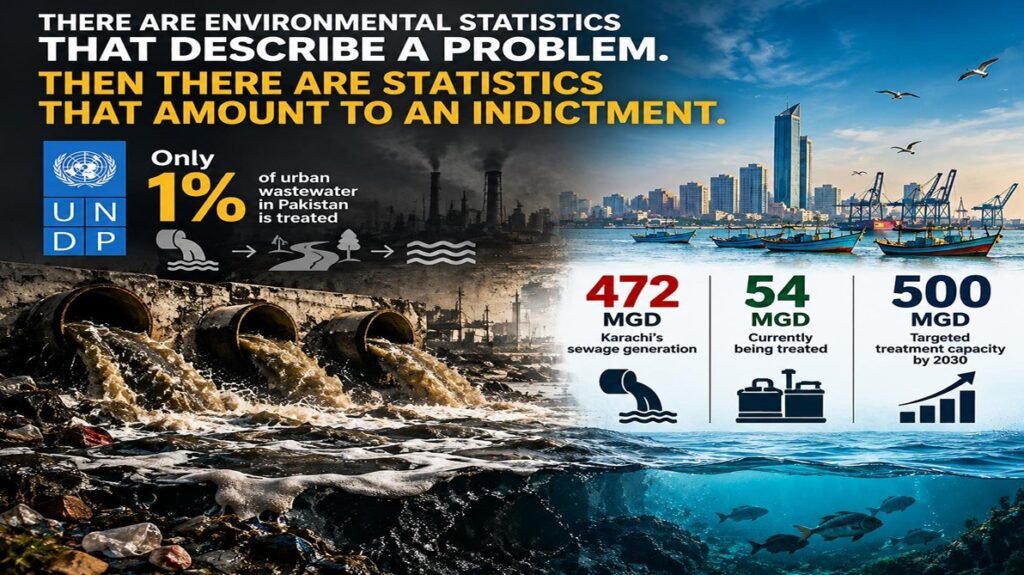
There are environmental statistics that describe a problem. Then there are statistics that demand accountability. A 2025 environmental report published by the United Nations Development Programme (UNDP) states that only 1% of urban wastewater in Pakistan is treated, while the remainder flows into streams and rivers without treatment, carrying toxic substances and heavy metals toward the sea. UNDP attributes the figure to the United Nations Environment Programme’s Environment and Climate Change Outlook of Pakistan.
In Karachi, that national warning becomes impossible to ignore. The Karachi Water & Sewerage Corporation (KW&SC) says the city generates about 472 million gallons per day (MGD) of sewage, while its three treatment plants currently treat only about 54 MGD. Rehabilitation and expansion are intended to lift treatment capacity to 500 MGD by 2030.
Those numbers should change the public debate. The question is no longer how many treatment plants Karachi has on paper, how much capacity has been announced, or how much money has been allocated. The question is simpler: how many gallons were actually treated yesterday — and did the treated effluent meet the required environmental standards?
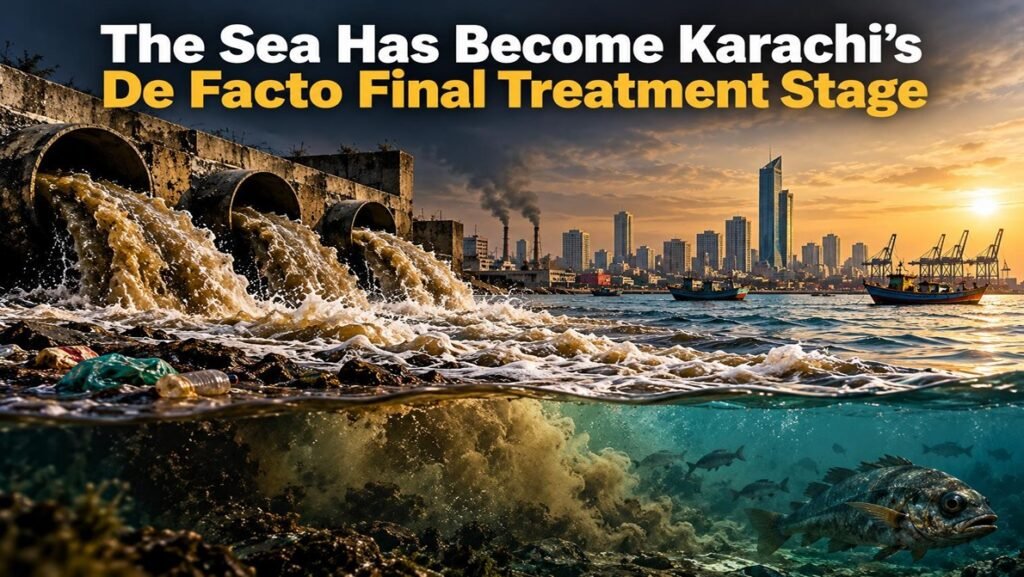
The Arabian Sea Cannot Remain Karachi’s Final Treatment Stage
The gap between 472 MGD generated and roughly 54 MGD treated should be interpreted carefully. It does not establish that every gallon in the difference is discharged directly and untreated into the Arabian Sea; wastewater moves through sewers, drains, rivers and other channels. But it does establish an extraordinary treatment deficit in Karachi’s principal municipal system.
The challenge also extends beyond domestic sewage. KW&SC says its network collects domestic, commercial and industrial wastewater and requires businesses to comply with Sindh Environmental Quality Standards before discharging into the municipal network. In proceedings reported in 2023, the Sindh Environmental Protection Agency (SEPA) told the Sindh High Court that Karachi’s seven industrial zones generated about 104 MGD of wastewater and that around 80 MGD of industrial wastewater was being dumped untreated into the sea, alongside large volumes of domestic effluent.
That distinction matters. Domestic sewage creates severe biological and public-health risks. Industrial effluent can add chemicals, heavy metals and other contaminants. When these costs are transferred to creeks, mangroves, fisheries and coastal waters, the apparent saving to a polluter becomes a liability borne by society.
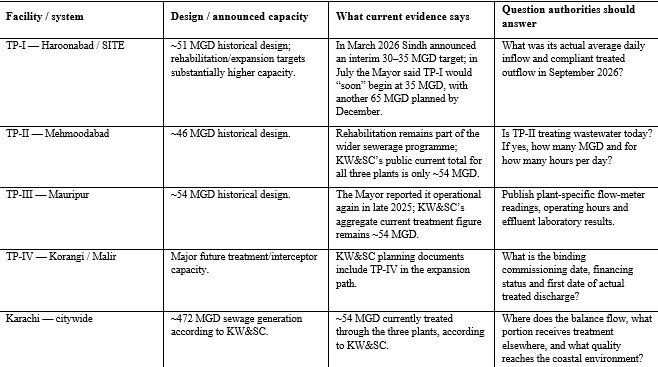
Karachi’s Wastewater Scorecard
The accountability test should separate design or announced capacity from verified current treatment. A plant is environmentally useful only to the extent that it is operating, treating water and producing compliant effluent.
Use the 700-MGD Estimate — But Label It Honestly
Published estimates differ. On 25 March 2025, The News International reported an estimate that 700 million gallons — 70 crore gallons — of untreated sewage from Karachi flows directly into the Arabian Sea daily. It is a striking figure, but it should not be presented as an official UNDP or KW&SC number. The responsible approach is to identify its source and contrast it with KW&SC’s current estimate of 472 MGD of sewage generation and other institutional figures.
The exact number deserves better measurement. The existence of a severe treatment deficit does not.
TP-I and the Problem of Capacity in the Future Tense
Karachi’s wastewater story is filled with capacity that exists in the future tense. TP-I illustrates the problem. In March 2026, the Sindh government approved Rs5 billion for secondary treatment and set an interim target of 30–35 MGD by June 30, with full operationalisation targeted for December 31. By July 31, the Mayor was reported as saying TP-I would “soon” begin operations at 35 MGD and that another 65 MGD was planned by December.
There is nothing wrong with rehabilitation, expansion or ambition. The problem begins when announced capacity substitutes for measured performance. A plaque can state capacity. Only a flow meter can establish performance.
Sindh Needs a Monthly Wastewater Dashboard
The Government of Sindh should not treat this as merely a municipal drainage issue. Karachi’s creeks, mangroves, coastline and fisheries are provincial economic assets, while its industrial estates generate jobs, taxes and exports. If wastewater pollution is degrading those assets, the environmental liability belongs on the province’s economic balance sheet.
KW&SC should be required to publish a monthly, plant-by-plant dashboard showing actual daily inflow, volume actually treated, operating hours, downtime, treatment level, prescribed effluent indicators such as BOD, COD and TSS, laboratory results and final discharge points. SEPA should publish parallel industrial-effluent compliance data for SITE, Korangi, Landhi and other industrial zones.
Measure it. Treat it. Test it. Publish it.
Why Islamabad Also Has a Stake
Karachi’s coastal wastewater problem is not exclusively a Sindh matter. Marine pollution intersects with national climate policy, biodiversity, fisheries, exports, maritime affairs, food security and Pakistan’s international environmental commitments.
The Ministry of Climate Change & Environmental Coordination should place Karachi’s wastewater treatment gap within Pakistan’s climate, biodiversity and SDG commitments. The Ministry of Maritime Affairs has an equally direct economic interest in marine health and fisheries. The Federal Government should work with Sindh on a transparent, independently verifiable wastewater-reduction roadmap and help mobilise climate, green and blue financing — but financing should be tied to measurable treatment outcomes.
KW&SC’s own SDG-6 presentation envisaged treatment rising from 54 MGD in 2024 to 255 MGD in 2027 and 500 MGD by 2030. Those targets already provide the outline of a public accountability framework.
Pollution Is Environmental Debt
The deeper economic issue is the externalisation of cost. An enterprise can retain the financial benefit of production while shifting part of its real cost onto the public. Pollution is a textbook example: revenue and exports are recorded, while damaged water, health, fisheries and ecosystems are left for society to absorb.
Consider a purely illustrative example. If an industrial unit creates US$1 million of economic value but its untreated effluent ultimately imposes US$1.5 million in health, ecological, fisheries and remediation costs, conventional accounts may celebrate the first number while failing to book the second. The US$1.5 million is not an estimate for any Pakistani industry; it simply illustrates the accounting problem.
That unrecorded liability is environmental debt: economic benefit enjoyed today while ecological and fiscal costs are transferred to citizens and future generations.
Protect a Marine Asset That Is Still Earning
The case for action does not require claiming that Pakistan’s seafood exports have collapsed. Available data show resilience. Pakistan Bureau of Statistics data cited by Dawn put FY2025–26 fish exports at about US$482 million and 215,170 tonnes, compared with US$465 million and 216,482 tonnes in FY2024–25 — a 3.6% rise in value alongside a 0.61% fall in quantity. The Ministry of Maritime Affairs separately announced a higher FY26 figure of US$568 million because of methodological differences.
That makes the environmental case stronger, not weaker. Pakistan already has a marine asset generating hundreds of millions of dollars in exports. Why expose the ecological foundation of that asset to avoidable sewage and industrial pollution? The better question is how much larger, safer and higher-value Pakistan’s blue economy could become if coastal water quality improved.
Make September 2026 the Baseline
There is an immediate opportunity to replace argument with evidence. KW&SC should publish the actual average daily inflow and treated outflow for TP-I, TP-II and TP-III for September 2026, together with operating hours, downtime and effluent-quality results. SEPA should publish corresponding water-quality readings for the major pathways into the Lyari River, Malir River, Korangi Creek and Karachi’s coastal waters, along with industrial-discharge compliance information.
Then Pakistan can establish a public trajectory: 2026 baseline → 2027 improvement → 2028 improvement → 2029 improvement → 2030 target. Government, industry, media and citizens would finally be debating measured performance rather than competing estimates.
Stop Counting Plants. Start Counting Gallons Treated.
A treatment plant should no longer be celebrated because its design document says 50 MGD. It should be judged by how many gallons it treated yesterday and whether the effluent leaving the plant complied with environmental standards.
A Rs5 billion allocation is not an environmental outcome. A groundbreaking ceremony is not an environmental outcome. A feasibility study is not an environmental outcome. A press conference announcing future capacity is not an environmental outcome. Clean, compliant water coming out of the other end is the outcome.
This is not an argument against industrialisation. It is an argument for industrialisation Pakistan can afford. Nor should a problem accumulated over decades be reduced to one mayor, one government or one political party. The responsibility now is institutional and measurable.
Karachi generates wealth for Pakistan every day. Its industries manufacture. Its ports handle trade. Its fisheries produce food and exports. Its coastline and mangroves provide ecological and economic services. Underneath that visible economy, however, runs another flow: the wastewater produced by a megacity and its industries. We measure the first flow meticulously in rupees and dollars. It is time we measured the second in million gallons per day.
About The Author