If Islamabad has failed, hand it over to Tharis, says Bilawal
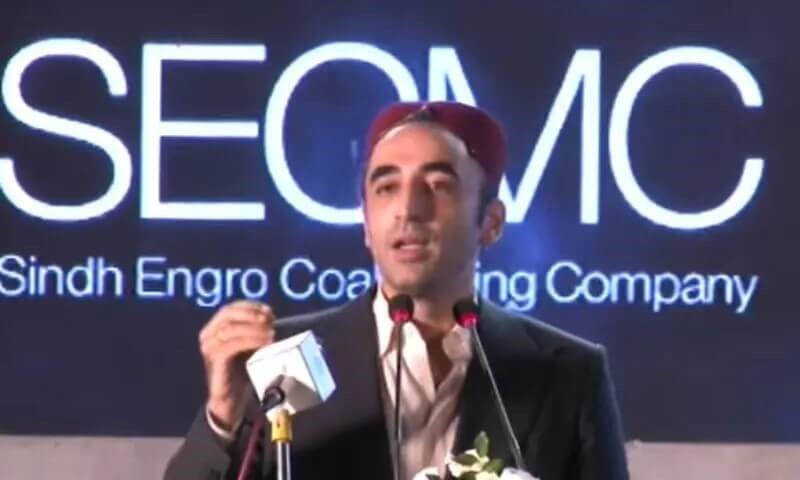
THARPARKAR: Pakistan People’s Party (PPP) Chairman Bilawal Bhutto Zardari has questioned the argument that new provinces should be created because the existing system has failed, saying that if Islamabad has failed, it should instead be handed over to the people of Tharparkar, who, he said, could fix it.
Addressing a ceremony in Tharparkar, Bilawal said, “I do not understand the logic that because the system has collapsed, new provinces should be created.” “If Islamabad has failed, hand it over to the people of Tharparkar. We will fix it,” he said.
Bilawal, CM Sindh Highlight Thar Coal Expansion and Energy Savings
Pakistan Peoples Party (PPP) Chairman Bilawal Bhutto Zardari and Sindh Chief Minister Syed Murad Ali Shah have highlighted the economic benefits of Thar coal projects, citing higher production, foreign exchange savings and job creation. The leaders visited Tharparkar on Monday for the inauguration of Phase III of the Thar Coal Block-II project.
Bilawal said Thar had demonstrated how public-private partnerships and investment in local communities could drive development. He urged Islamabad to adopt similar development initiatives across the country.
Thar Coal Expansion to Boost Production and Power Generation
Chief Minister Murad Ali Shah said Phase III would increase annual coal production from 7.6 million tonnes to 11.2 million tonnes. The expansion would add 3.6 million tonnes to annual output.
He said the project was being completed with 100% self-financing. According to the chief minister, electricity generated from locally produced Thar coal would cost around one-third as much as power generated using imported coal.
Murad Ali Shah added that a 660-megawatt Lucky Electric power plant would also operate on Thar coal under Phase III. With the project’s completion, total power generation from Thar would reach 1,980 megawatts.
He said the additional generation capacity would support around 4.5 million households daily. The project could also save approximately Rs15 billion annually in electricity generation costs.
Thar Coal Projects to Save Foreign Exchange and Create Jobs
Bilawal said Thar Block-II was currently generating around 600 megawatts of electricity. He also referred to plans for further expansion, saying power generation associated with Thar Block-III would reach around 2,000 megawatts.
He recalled that some experts had previously questioned the commercial value of Thar coal. Bilawal said its use was now helping Pakistan save foreign exchange by reducing reliance on imported fuels.
The PPP chairman also highlighted the use of Thar coal in producing gas and fertiliser. He stressed the need to complete the proposed coal-to-fertiliser project as soon as possible.
Murad Ali Shah said Phase III would save around $220 million annually in foreign exchange. He added that existing Thar coal projects had already generated foreign exchange savings exceeding $1.7 billion.
Bilawal also highlighted local employment, saying around 90% of jobs in Thar were being provided to young people from Sindh. He added that residents of Thar accounted for 60% of employment in the projects.
Sindh Government Plans New Investment Zones
Bilawal said Sindh wanted to extend its development model to Karachi and Islamabad through public-private partnerships. He added that the provincial government planned to establish Sindh Investment Zones under the same model.
The government also intends to develop a port in Thatta through a public-private partnership, he said.
Murad Ali Shah said the Sindh government had invested in basic infrastructure to support Thar’s development. These facilities include roads, an airport, water supply systems and electricity transmission infrastructure.
He noted that Thar holds estimated coal reserves of around 175 billion tonnes, discovered in the 1990s. He also referred to the early development of coal-fired power projects and the federal government’s sovereign guarantee for the Thar Coal project in 2013.
The chief minister said Thar Block-II was among the projects that delivered early benefits under the China-Pakistan Economic Corridor (CPEC). He added that independent power producers were gradually shifting from imported coal to locally produced Thar coal.
About The Author