Oil Prices Fall for Fourth Day as Iran War Risks Ease
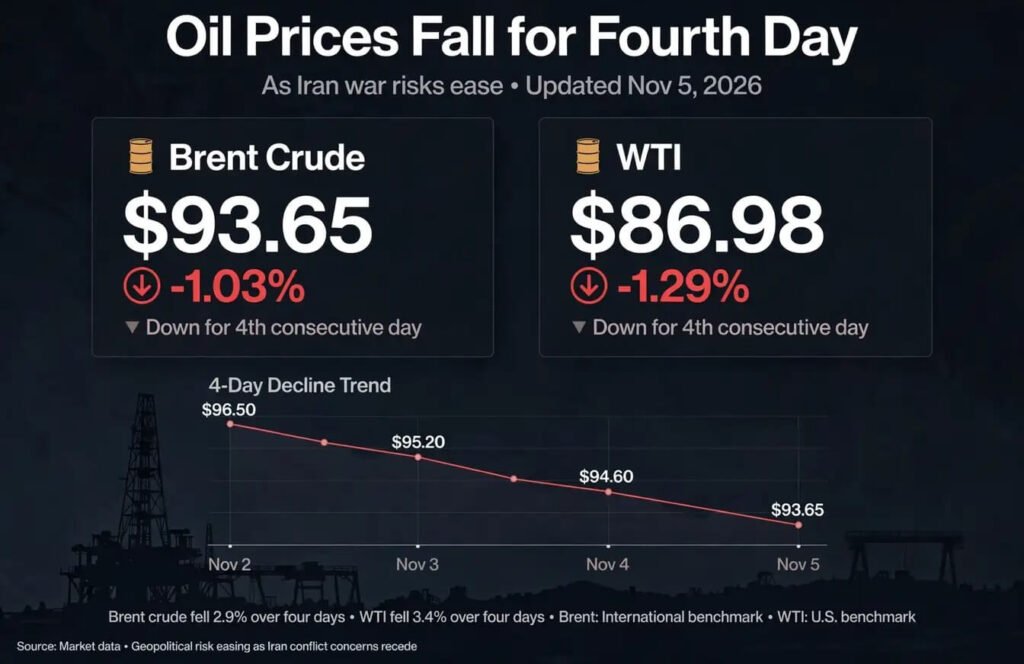
SINGAPORE: Global oil prices declined for a fourth consecutive day on Thursday as investors anticipated a lower risk of further escalation in the US-Israeli war on Iran following political setbacks for US President Donald Trump’s Republican Party in congressional elections.
Brent crude futures fell 97 cents, or 1.03%, to $93.65 a barrel, while US West Texas Intermediate (WTI) crude dropped $1.14, or 1.29%, to $86.98 as of 0211 GMT.
Both benchmarks plunged by more than 8% in the previous trading session, settling at their lowest levels since August 31.
US Election Results Weigh on Oil Prices
Investors are increasingly hopeful that the Republican Party’s losses in the congressional elections could encourage President Trump to pursue diplomatic efforts to end the conflict with Iran.
According to two sources close to Gulf government circles, a weakened Trump may face greater pressure from a Democratic-controlled Congress, potentially limiting his military options and making a diplomatic agreement more attractive.
Consequently, the possibility of a full-scale US assault on Iran appears less likely, the sources said.
June Goh, senior oil analyst at Sparta Commodities, said markets were assessing how the election results could influence Trump’s next steps in the Iran war, with investors pricing in a greater possibility of the conflict ending.
Strait of Hormuz Oil Shipments Recover
Meanwhile, the resumption of oil shipments through the Strait of Hormuz is providing additional relief to global energy markets.
The strategic waterway, which handles a significant portion of global oil supplies, has seen crude shipments recover close to pre-war levels, although transportation costs remain elevated.
Furthermore, JPMorgan said the restoration of Gulf oil supplies had pushed the global oil market back into surplus following months of disruption caused by the conflict.
The bank estimated that the global oil market recorded a surplus of 1.1 million barrels per day in September. This increased to 1.4 million barrels per day in October, approaching last year’s average surplus of 1.3 million barrels per day.
Oil Market Volatility Remains a Concern
Despite the recent decline, analysts warn that lower oil prices may not last.
Mukesh Sahdev, chief executive of energy consultancy XAnalysts, said geopolitical risks remained difficult to predict and that the election outcome would not immediately change US policy.
He also pointed out that the new Congress would not take office until January, meaning Washington’s existing policy options remained unchanged for now.
Moreover, commercial oil inventories in major consuming countries are close to their lowest levels in 15 years, potentially limiting further price declines.
Sahdev also warned that Iran could emerge from the US election outcome with greater determination.
US Oil Inventories Decline Amid Strong Demand
Adding to market uncertainty, US crude oil, gasoline and distillate inventories all declined last week, according to the Energy Information Administration (EIA).
The agency also reported that US oil demand reached its highest level in a year.
Lower inventories and stronger demand could provide support to oil prices, even as expectations of reduced geopolitical tensions weigh on the market.
Overall, investors will continue monitoring developments in the US-Iran conflict, oil supply through the Strait of Hormuz and global inventory levels for further direction.
About The Author