Political Betting Surges to $1.1bn Ahead of US Midterm Elections
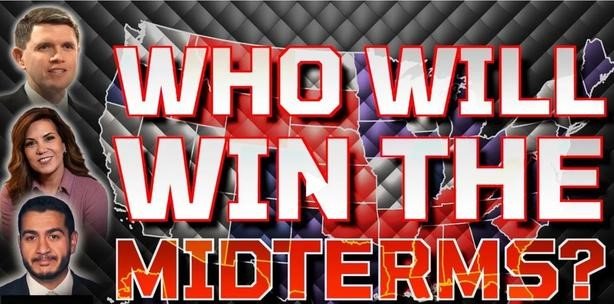
Kalshi’s latest market estimates show that traders see Democrats as having a 93% chance of gaining control of the House of Representatives.
Political betting is gaining momentum in the United States ahead of the midterm elections, with millions of dollars being wagered on the outcomes of congressional, Senate and gubernatorial races.
The growing interest in election betting has turned prediction websites into a major part of the US political landscape. One of the leading platforms, Kalshi, has recorded significant trading activity as voters prepare to decide control of Congress.
According to available figures, Kalshi recorded approximately $454.2 million in trading volume over the past 30 days. Meanwhile, different US media reports suggest that election-related trading across prediction markets reached nearly $1.1 billion by the final week of October.
Democrats Lead in Kalshi’s Election Predictions
Kalshi’s latest market estimates show that traders see Democrats as having a 93% chance of gaining control of the House of Representatives. Meanwhile, Republicans have a 7% implied probability. The Senate control market also shows a higher implied probability for Democrats.
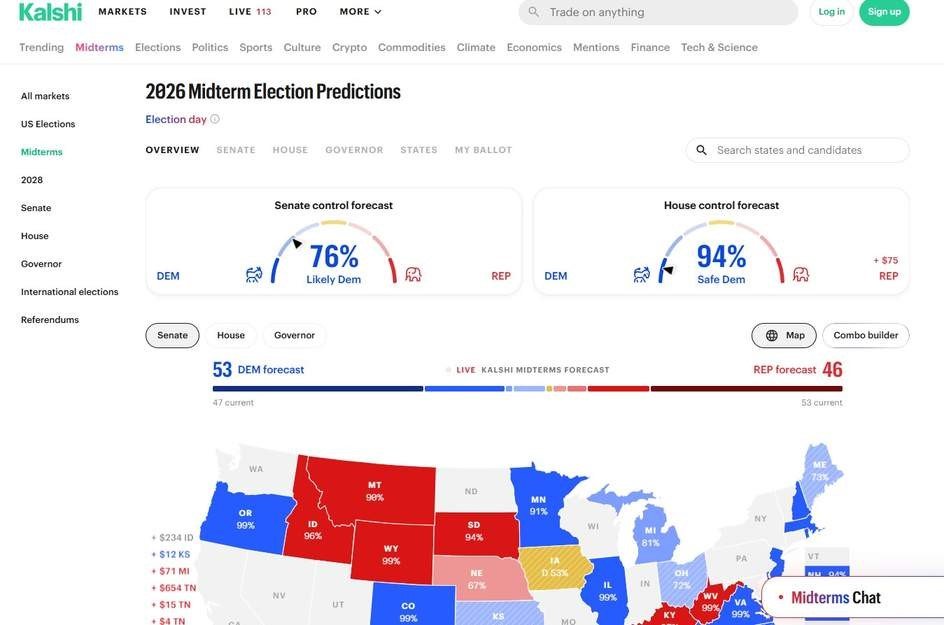
According to Kalshi, traders currently assign Democrats a 72% chance of controlling the Senate, compared with 28% for Republicans. These figures reflect market-based expectations rather than official election forecasts or guaranteed results.
Election Betting Draws Growing Attention
The rising volume of political betting highlights the growing role of prediction markets in US elections.
Platforms such as Kalshi allow users to trade event contracts linked to political developments and election outcomes.
As a result, election-related trading has attracted increasing attention from financial markets, political observers and the media.
With congressional and gubernatorial races drawing national attention, trading activity is expected to remain a major talking point as the US midterm elections approach.
That is Democrats’ strongest Senate showing on the platform since trading began, according to CNBC. Polymarket traders gave Democrats 73%, according to Benzinga.
The latest jump followed a New York Times and Siena University survey that put Democrats in front across multiple swing states. Republicans held the advantage on the market from its 2024 opening, and their odds of controlling the Senate peaked at 60% in July, then turned around by the middle of September.
Republicans hold 53 Senate seats, and Democrats hold 47, including two independents who caucus with them. With 35 seats up for election, Democrats need a net gain of four to take control. A three-seat gain would produce a 50-50 Senate, and Vice President JD Vance could cast tie-breaking votes to preserve Republican control.
Online betting is a bit like Donald Trump.
The prediction markets – platforms where users bet on whether events will occur – pretend to be populist, pushing the nabobs aside and representing the “wisdom of the crowd”. “This data is bottom-up, not elites-driven,” a Kalshi spokesperson told Reuters. But in fact, the markets are controlled by a few, skillful traders.
Their users are led to believe they can strike it rich. But like gamblers everywhere, most of them lose most of the time, while enriching the casino and bankrolling the winner’s takings.
The markets pretend honesty and transparency, but they open the door to fraud and insider trading.
“Prediction markets are a way to see what people are saying when there’s money on the line,” said the Kalshi spokesperson. When money talks, in other words, its message is more authentic and valuable than mere political speech.
More recent analyses suggest that the betting masses are not so wise after all. A new working paper from scholars at the London Business School and Yale University looked at publicly available trading data from Polymarket. Whereas almost every wagerer’s outcomes were no better than chance, they discovered, the “accuracy comes from a minority of persistently skilled traders, around 3% of accounts”. The crowd “generates most of the volume but little of the information”.
About The Author