Pakistan’s External Debt Doubles to $135.1bn in 2025: WB
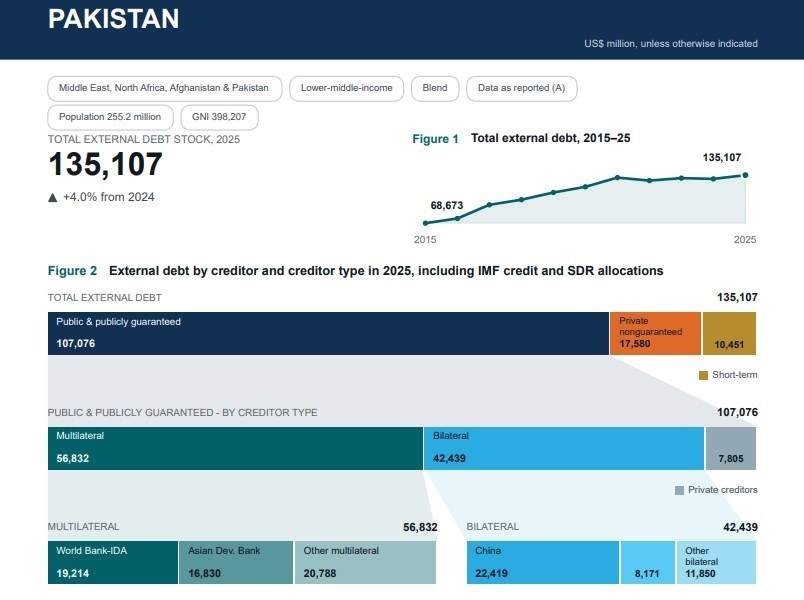
KARACHI: Pakistan’s external debt nearly doubled over the past decade, reaching $135.1 billion in 2025, compared with $68.67 billion in 2015, according to the World Bank’s International Debt Report 2026.
The report highlights the growing burden of external borrowing on Pakistan’s economy, with government and publicly guaranteed debt accounting for the largest share of the country’s total external liabilities.
According to the report, Pakistan’s total external debt stood at $135.107 billion in 2025. Of this amount, $107.076 billion consisted of public and publicly guaranteed debt, while $17.58 billion represented private sector borrowing that was not guaranteed by the government. Short-term external debt accounted for another $10.45 billion.
China Emerges as Pakistan’s Largest Individual Creditor
The World Bank report identifies China as Pakistan’s largest individual bilateral creditor, with approximately $22.4 billion in outstanding loans. Pakistan also owes $19.2 billion to the World Bank and $16.83 billion to the Asian Development Bank (ADB).
The breakdown of Pakistan’s public external debt shows that: $56.83 billion is owed to multilateral financial institutions. $42.43 billion is owed to other countries. $7.8 billion is owed to private creditors.
These figures highlight Pakistan’s continued reliance on international financial institutions and bilateral lending partners to meet its external financing requirements.
Interest Rates and Repayment Periods Differ Significantly
The report also highlights a considerable difference between the borrowing terms offered by official creditors and private lenders. Loans obtained from official financial institutions have an average repayment period of 16 years, with an average interest rate of 3.6%.
These loans also carry an average grace period of four years before repayment begins.
In contrast, borrowing from private creditors is considerably more expensive. Such loans carry an average interest rate of 8.6%, with an average repayment period of just three years and a grace period of only one year.
The difference reflects the relatively higher cost and shorter repayment schedules associated with private external borrowing.
External Debt-to-GNI Ratio Rises Across the Region
The World Bank report further notes that the Middle East, North Africa, Afghanistan and Pakistan (MENAAP) region recorded improvements in debt repayment and interest payment ratios.
However, the region’s external debt-to-gross national income (GNI) ratio increased from 26.7% in 2024 to 29.4% in 2025.
According to the report, this represented the largest annual increase in the ratio among all regions, highlighting growing external debt pressures across the region.
China Extends $2 Billion in Loans to Pakistan
The report also reveals that China extended the repayment period for $2 billion in loans provided to Pakistan during 2025.
The International Monetary Fund (IMF) provided Pakistan with $2.3 billion in fresh financing under its Extended Fund Facility (EFF) and Resilience and Sustainability Facility (RSF).
The additional financing and repayment extensions underline Pakistan’s continued dependence on external financial support as it manages its debt obligations and broader economic challenges.
Pakistan Faces Growing External Debt Challenges
The increase in Pakistan’s external debt to $135.1 billion underscores the challenges facing the country’s economy, particularly in managing debt servicing costs, maintaining foreign exchange reserves and meeting international financial obligations.
The growing share of external borrowing also highlights the importance of sustainable debt management, export growth, foreign investment and stronger economic fundamentals to reduce dependence on external financing.
About The Author